
Vol. 1 · No. 37 · FreeSeptember 9

THE COUNTIO CHRONICLE

The World's Growing Library of Actionable Knowledge
Home·Editorial·Career
Intermediate8 min read

July 2026 · Volume 1 · Issue 29

Designing Spaces That Help You Focus

Focus is not a personality trait. It is an environmental outcome. Here is how to design spaces that make deep work the default rather than the exception.

Published July 18, 2026
focusworkspace designdeep workproductivityconcentrationenvironmental designhome office

We tend to treat focus as a personal failing. If you cannot concentrate, the thinking goes, you lack discipline. But the environments most of us work in are engineered for the opposite of focus. They are full of competing stimuli, visual noise, and design choices that fragment attention at every turn. Before you blame yourself, look at your space.

Designing Spaces That Help You Focus

The Problem with 'Just Sit Down and Concentrate'

Focus is not a switch you flip. It is a state you enter — and the environment either supports that entry or fights it. A desk facing a high-traffic area, a room with three notification sources, a chair that reminds you of discomfort every thirty seconds: these are not neutral elements. They are active obstacles to concentration.

The most productive people are not necessarily the most disciplined. They are the ones who have arranged their environment so that focus is the path of least resistance.

The Three Layers of Focus Design

Designing for focus operates on three layers, each building on the last:

Layer one: removal. Before adding anything, remove what competes for attention. Visible clutter, unrelated tasks, open browser tabs, phones within arm's reach. Each removed competitor raises the ceiling of how deep you can go.

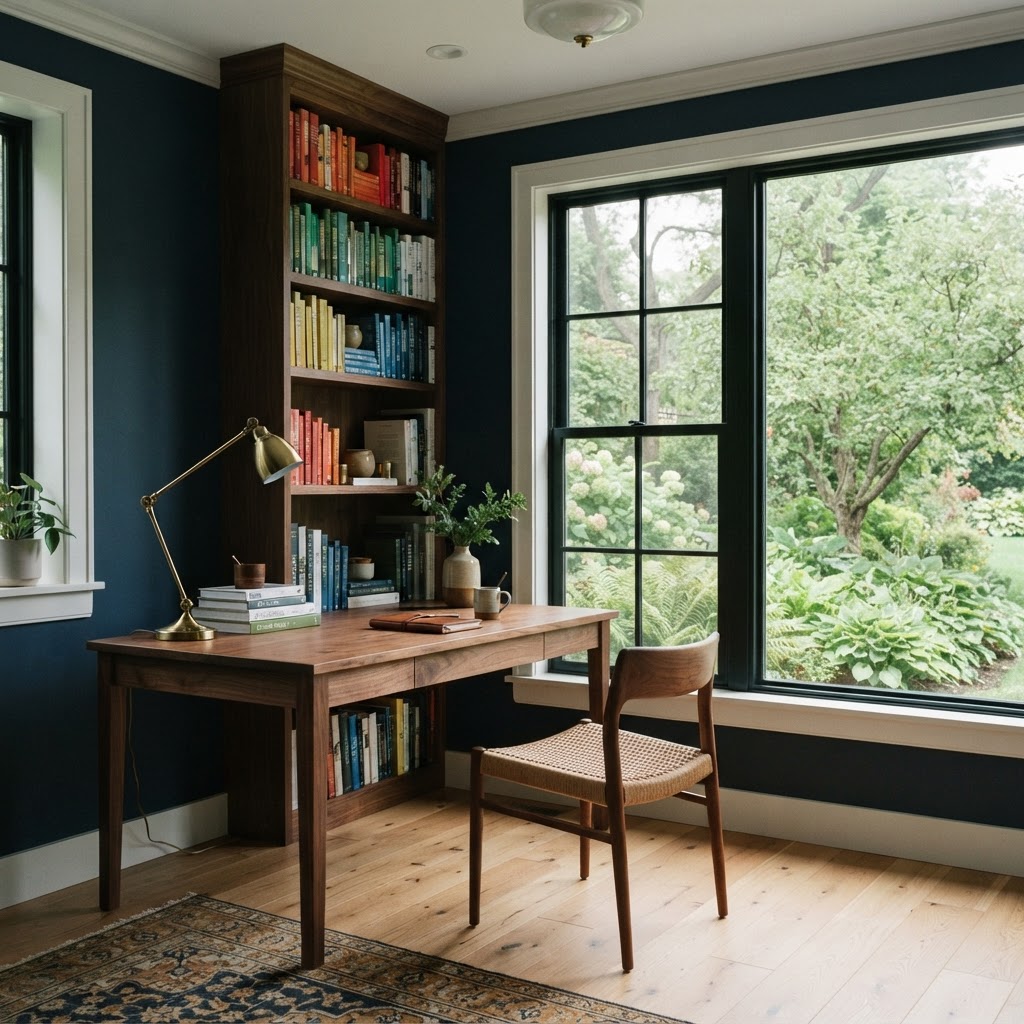
Layer two: arrangement. Position what remains so that the tools you need are within reach and the distractions are not. Face a wall or a window, not a doorway. Keep the phone in another room, not on the desk. The geometry of your workspace shapes your attention.

Layer three: atmosphere. Lighting, sound, and temperature set the physiological conditions for sustained focus. Warm, directional light. A sound environment that is either genuinely quiet or consistently ambient. A temperature cool enough to keep you alert.

Your environment is not the background of your work. It is a participant in it.

Removing the Competing Stimulus

Every visible object in your workspace is a potential thought. The stack of bills. The laundry that needs folding. The book you started and abandoned. Your brain registers each one, files it as unfinished, and uses a small amount of processing power to keep it in the queue.

This is why a clear desk is not about aesthetics. It is about cognitive bandwidth. When the only visible objects are the ones related to the task at hand, your full attention is available for that task. The clutter is not just messy — it is expensive.

The Sensory Profile of Deep Work

Deep work has a sensory signature. It tends to happen in spaces that are visually quiet, acoustically controlled, and thermally comfortable. Notice where you do your best thinking — it is probably not a busy cafe with a flickering overhead light and a draft.

You can engineer this signature deliberately. Position your desk so that your visual field contains only what is relevant. Use noise-canceling headphones or consistent ambient sound. Control the temperature. These are not luxuries — they are the infrastructure of sustained concentration.

Designing for Different Kinds of Focus

Not all focus is the same. Creative work benefits from gentle stimulation — a window, some ambient sound, visual variety. Analytical work benefits from minimal stimulation — a clean wall, silence, a single task. Administrative work can tolerate more noise but needs clear organization.

The mistake is designing one space for all three. If possible, create different zones for different kinds of work. If not, make the space adaptable: a desk that can face a wall for deep work and a window for creative thinking. The flexibility is in the arrangement, not the furniture.

Your Environment Is Your Strategy

Focus is not something you muster. It is something you design for. When your space is engineered for concentration — clear of competitors, arranged for the task, atmospherically supportive — deep work becomes the default state rather than the exception.

Before you try harder to focus, try redesigning the space you focus in. The discipline you think you lack may simply be an environment you have not yet built.

Continue Your Planning