
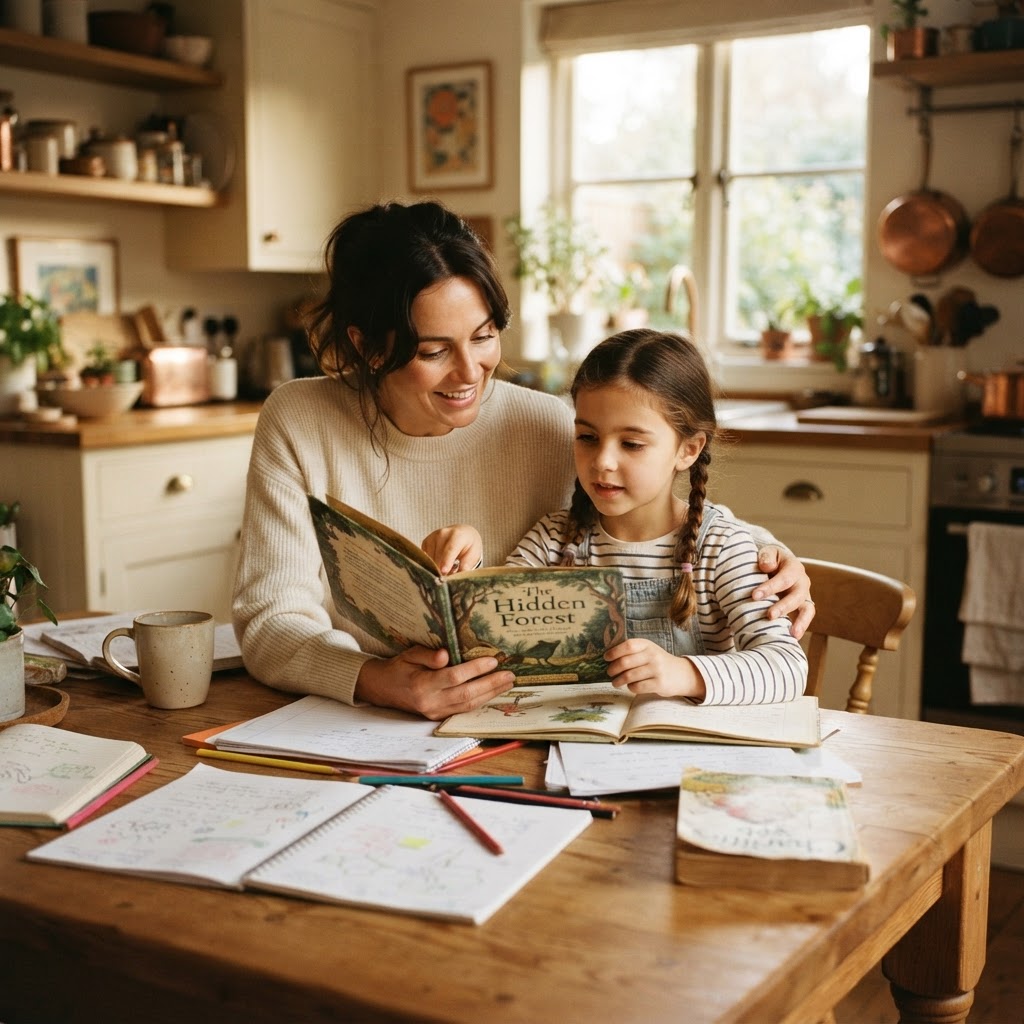
The Home as Learning Environment
The home is a learning environment, whether the parent intends it to be or not. The child who grows up in a home with books, conversation, curiosity, and engagement is learning, constantly, that learning is valued, that ideas are interesting, and that the world is worth exploring. The child who grows up in a home without these elements is learning something different — that learning is a school activity, not a life activity, and that the world is to be navigated rather than explored. This learning, which is not taught but absorbed, shapes the child's entire approach to education, and the approach, established in the earliest years, persists throughout the child's academic career and beyond. The parent who understands this — who recognizes that the home is always teaching, whether deliberately or not — can shape what the home teaches, through the environment, the activities, and the culture that they create. The home that is deliberately shaped as a learning environment — with accessible books, engaging conversations, opportunities for exploration, and the modeling of curiosity — provides a foundation that no school, however excellent, can replace, because the foundation is present every day, in every interaction, and is shaped by the people the child most loves and trusts.
Your home is teaching your child, right now, whether you intend it or not. The question is not whether the home teaches. It is what the home teaches.
Curiosity as the Foundation
The most valuable attitude toward learning that a home can cultivate is curiosity — the genuine interest in how things work, why things happen, and what things mean. Curiosity, unlike academic performance, is not a skill that can be tested. It is an orientation toward the world — a disposition to wonder, to question, and to explore — and it is the foundation of all genuine learning, because without curiosity, learning is compliance rather than engagement, and compliance produces knowledge without understanding. The parent who cultivates curiosity does so not through instruction but through modeling and response: modeling curiosity by asking questions, exploring interests, and engaging with the world's complexity, and responding to the child's questions with genuine engagement rather than dismissal or immediate answers. The child who asks 'why is the sky blue?' and receives either dismissal ('it just is') or an immediate answer (the scientific explanation) learns different things: the first that questions are not welcome, the second that answers come from others. The child who receives the response 'that's a great question, what do you think?' learns something else: that questions are valued, that exploration is encouraged, and that the child's own thinking matters. This response, maintained consistently, cultivates the curiosity that is the foundation of all genuine learning, and the curiosity, once established, drives the child's learning far more powerfully than any curriculum or instruction.
Beyond Homework
The common understanding of parental involvement in learning is homework help — the parent assisting with assignments, checking completion, and ensuring that schoolwork is done. This involvement, while practically valuable, is a narrow conception of the parent's role in learning, because it defines learning as schoolwork and the parent's role as supporting the school. The broader conception — learning as a life activity and the parent's role as cultivating the attitudes, habits, and environment that support all learning — includes homework help but extends far beyond it. It includes: reading together (one of the most powerful practices for developing literacy, vocabulary, and the love of reading), conversation (the discussions at meals, in the car, at bedtime that develop language, thinking, and connection), exploration (the visits to museums, parks, and places that expand the child's world), making (the projects, creations, and activities that develop skills and creativity), and modeling (the parent's own engagement with learning, whether through reading, courses, or interests, which demonstrates that learning is a lifelong activity, not a childhood obligation). These practices, maintained consistently, create a home where learning is not a task but a culture, and the culture, once established, supports the child's learning far more powerfully than homework help alone could, because it develops the attitudes and habits that drive all learning, not just the completion of assignments.
Reading as the Keystone
If there is a single practice that most powerfully supports learning at home, it is reading — the regular, shared, and modeled engagement with books. Reading to children, from the earliest age, develops vocabulary, language comprehension, attention span, and the knowledge of the world that underlies all subsequent learning. Reading with children, as they develop their own skills, provides support, modeling, and the shared experience that makes reading a social rather than solitary activity. Reading alongside children — the parent reading their own books while the child reads theirs — models reading as a valued, lifelong activity, rather than a childhood task. And reading environments — homes with accessible books, comfortable reading spaces, and regular reading times — make reading a natural part of daily life rather than a special event. The child who grows up in a reading home arrives at school with advantages that are difficult to overstate: larger vocabularies, stronger comprehension, broader knowledge, and the habit of reading that drives all subsequent learning. The parent who reads with their child, consistently and over years, provides a foundation that supports every aspect of the child's education, and the foundation, built through thousands of reading sessions, is among the most valuable educational investments a parent can make.
The Attitude Toward Learning
Ultimately, the most important thing the home teaches about learning is the attitude toward it — whether learning is experienced as a joy or a burden, as an opportunity or an obligation, as a lifelong activity or a childhood task. This attitude, which is absorbed from the home's culture rather than taught through instruction, shapes the child's entire approach to education and to life. The child who absorbs the attitude that learning is joyful, valuable, and ongoing approaches school, and life, with curiosity and engagement. The child who absorbs the attitude that learning is a burden, to be completed and set aside, approaches school, and life, with compliance and detachment. The parent who shapes this attitude — through the environment, the activities, the modeling, and the responses that communicate what learning is and why it matters — provides the most fundamental support for learning that any parent can provide, because the attitude, once established, drives the child's learning long after the parent's direct involvement has ended, and the attitude, positive or negative, is among the most enduring legacies of the home.
Supporting learning at home is not about replicating school or supplementing the curriculum. It is about creating the environment, the culture, and the practices that make learning a natural, valued, and ongoing part of the child's life. Shape the home as a learning environment. Cultivate curiosity. Go beyond homework. Make reading the keystone. Shape the attitude toward learning. The home that does this, maintained over years, provides a foundation that supports all of the child's learning, in school and beyond, and the foundation, built through the daily culture of the home, is among the most powerful educational influences in the child's life — more powerful, in many cases, than the school itself, because it is present every day and is shaped by the people the child most loves.