
Vol. 1 · No. 37 · FreeSeptember 9

THE COUNTIO CHRONICLE

The World's Growing Library of Actionable Knowledge
Work & Money·Practical Guide·Career
Beginner8 min read

Designing a Productive Workspace

Your workspace is not just where you work. It is an environment that either supports or undermines your focus, energy, and wellbeing — every single day.

Published July 18, 2026
workspace designproductivitywork environmentremote workwellness

The workspace is the most overlooked determinant of work quality. Not because it is unimportant — it is arguably one of the most important — but because it is so familiar that it becomes invisible. The quality of your chair affects your physical wellbeing. The quality of your lighting affects your energy and mood. The organization of your desk affects your cognitive efficiency. The noise level affects your ability to focus. The presence or absence of natural light affects your circadian rhythm. Every element of the workspace — the physical, the visual, the auditory, the environmental — shapes the quality of the work that is done in it, not occasionally but continuously, every hour of every day. A well-designed workspace is not a luxury or an aesthetic preference. It is a practical investment in the quality, sustainability, and health of your work, and it is one of the highest-leverage improvements available to any professional.

Designing a Productive Workspace

The Environment Shapes the Work

The relationship between environment and work quality is not subjective. It is well-documented and measurable. Natural light improves mood, energy, and cognitive function, and its absence degrades all three. A comfortable, ergonomically appropriate chair prevents the physical problems — back pain, neck strain, tension headaches — that accumulate from poor posture and undermine both comfort and focus. A quiet environment, or one with appropriate ambient sound, supports the deep concentration that complex work requires, while a noisy environment fragments attention and increases stress. An organized, visually calm workspace reduces cognitive load — the mental overhead of managing visual chaos — and frees that capacity for the work itself. The environment is not a neutral backdrop. It is an active participant in the work, shaping the quality, efficiency, and sustainability of everything that is done in it. The professional who designs their workspace intentionally works better, feels better, and sustains their work longer than the one who does not.

Your workspace is not where you work. It is how you work. The environment shapes the effort, the focus, and the quality — every hour, every day, without asking.

The Physical Foundation

The physical foundation of a productive workspace includes several elements. The chair is the most important — it should be ergonomic, adjustable, and supportive, because the hours spent in it directly affect physical wellbeing and, through it, cognitive function. The desk should be at the right height, large enough for the work being done, and organized to keep essential items accessible and non-essential items out of the way. The monitor should be at eye level, at a comfortable distance, positioned to reduce neck strain and eye fatigue. The keyboard and mouse should be comfortable and positioned to prevent wrist strain. These elements, which seem mundane, are the foundation of physical comfort, and physical comfort is the foundation of sustained work — the person who is physically uncomfortable cannot focus fully, regardless of their motivation or discipline. The investment in quality physical equipment is one of the highest-return investments a professional can make, because it pays dividends every working hour for years.

Light and Air

Beyond the physical equipment, the environmental qualities of the workspace — light and air — have significant effects on work quality and wellbeing. Natural light is the most important: it synchronizes the circadian rhythm, improves mood, and enhances cognitive function. A workspace with access to natural daylight, particularly in the morning, supports both immediate work quality and long-term health. When natural light is insufficient or unavailable, the quality of artificial light matters — full-spectrum or warm light, positioned to reduce glare and eye strain, is better than the harsh fluorescent lighting that many workplaces use. Air quality, though less visible, is equally important: a stuffy, poorly ventilated workspace produces drowsiness and reduced cognitive function, while fresh air, whether from windows or air purification, maintains alertness and clarity. These environmental qualities, often overlooked, have daily, continuous effects on the quality of work, and their optimization is a practical investment in sustained performance.

Organization and Visual Calm

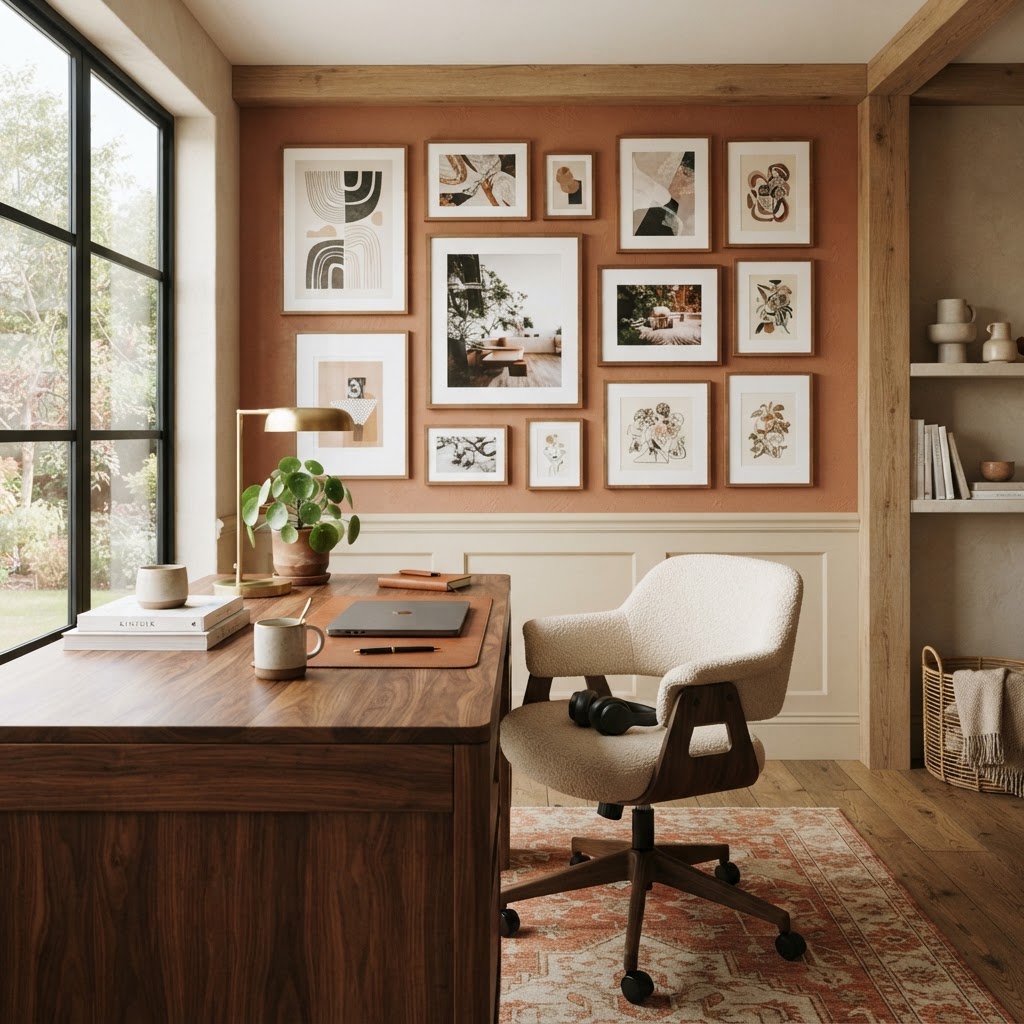
The visual environment of the workspace — the organization, the clutter, the visual noise — affects cognitive efficiency. A cluttered, disorganized workspace creates visual chaos that competes for attention, increasing cognitive load and reducing the capacity available for focused work. An organized, visually calm workspace reduces this load, freeing cognitive capacity for the work itself. This does not mean minimalism — some people work well in environments that are visually rich, and the optimal level of visual stimulation varies by individual. But it means intentionality — the visual environment is designed, not accidental, with the elements that support focus present and the elements that distract removed. For most people, this means: a clear primary work surface with only the current task's materials, essential tools organized and accessible, non-essential items stored out of sight, and personal elements (plants, art, objects) that provide warmth without distraction. The workspace that is intentionally organized supports the work. The workspace that is accidentally cluttered undermines it.

The Workspace as a Tool

Ultimately, the workspace should be understood as a tool — not a passive setting but an active instrument that, when well-designed, enhances the work done in it. Like any tool, its effectiveness depends on its design, its maintenance, and its alignment with the work it supports. A workspace designed for deep, focused work will emphasize quiet, organization, and minimal distraction. A workspace designed for collaborative work will emphasize communication, shared tools, and social interaction. A workspace designed for creative work will emphasize inspiration, visual richness, and comfort. The design should match the work, and the professional who understands this — who designs their workspace not according to generic standards but according to the specific work they do — creates an environment that actively supports their best work, every day, for as long as they use it.

Designing a productive workspace is not a luxury or an aesthetic preference. It is a practical investment in the quality, sustainability, and health of your work. Build the physical foundation. Optimize light and air. Maintain organization and visual calm. Design for the specific work you do. The workspace that results, however modest, is not just where you work. It is an environment that actively shapes the quality of everything you produce in it.

Continue Your Planning